Geeta 1.1-Where It All Begins —Uncovering the Hidden War Within
Geeta 1.1
1. Verses and Translation
Dhṛtarāṣṭra Uvācha
धृतराष्ट्र उवाच
धर्मक्षेत्रे कुरुक्षेत्रे समवेता युयुत्सवः।
मामकाः पाण्डवाश्चैव किमकुर्वत सञ्जय॥ 1.1॥
Translation (Simple Meaning):
Dhritarashtra said: “O Sanjaya, assembled in the holy land of Kurukshetra, eager for battle, what did my sons and the sons of Pandu do?”
2: Not Confusion — But the Stubbornness to Not Change
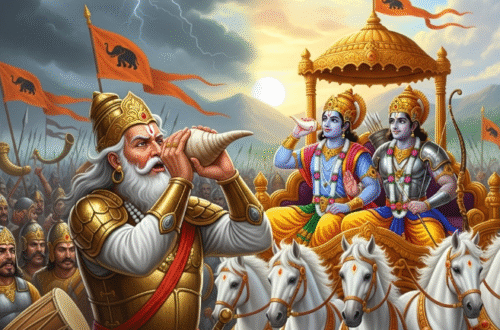
The Bhagavad Gita begins with a question — not from Arjuna, not from Krishna, but from Dhritarashtra, the blind king. And this first voice isn’t a confusion. It’s something much more relatable — the voice of someone who knows what is right but still refuses to change.
He asks, “What did my sons and the sons of Pandu do, Sanjaya?” as if he doesn’t know why two massive armies have gathered on a battlefield. As if he’s unaware of the years of humiliation, injustice, and silence that brought them there. But deep down, he knows. He knows exactly what’s happening — and still pretends not to.
Just like we all do.
We skip the preparation and still hope to pass the exam. We avoid the hard decisions and still pray for peace. We live in a way that we know are unsustainable — with our health, our relationships, our duties — and yet we wait, hoping for a miracle to save us from the results we clearly deserve.
That’s Dhritarashtra syndrome. Not blind in sight — but blind in will. Bound by ego. Paralyzed by habit. Unable to let go of attachment, even when it is leading him — and his entire family — toward destruction.
He knows the war will destroy everything. He knows dharma isn’t standing with him. But the part of him that should speak up, step back, stop the war — is too weak. Or maybe too late.
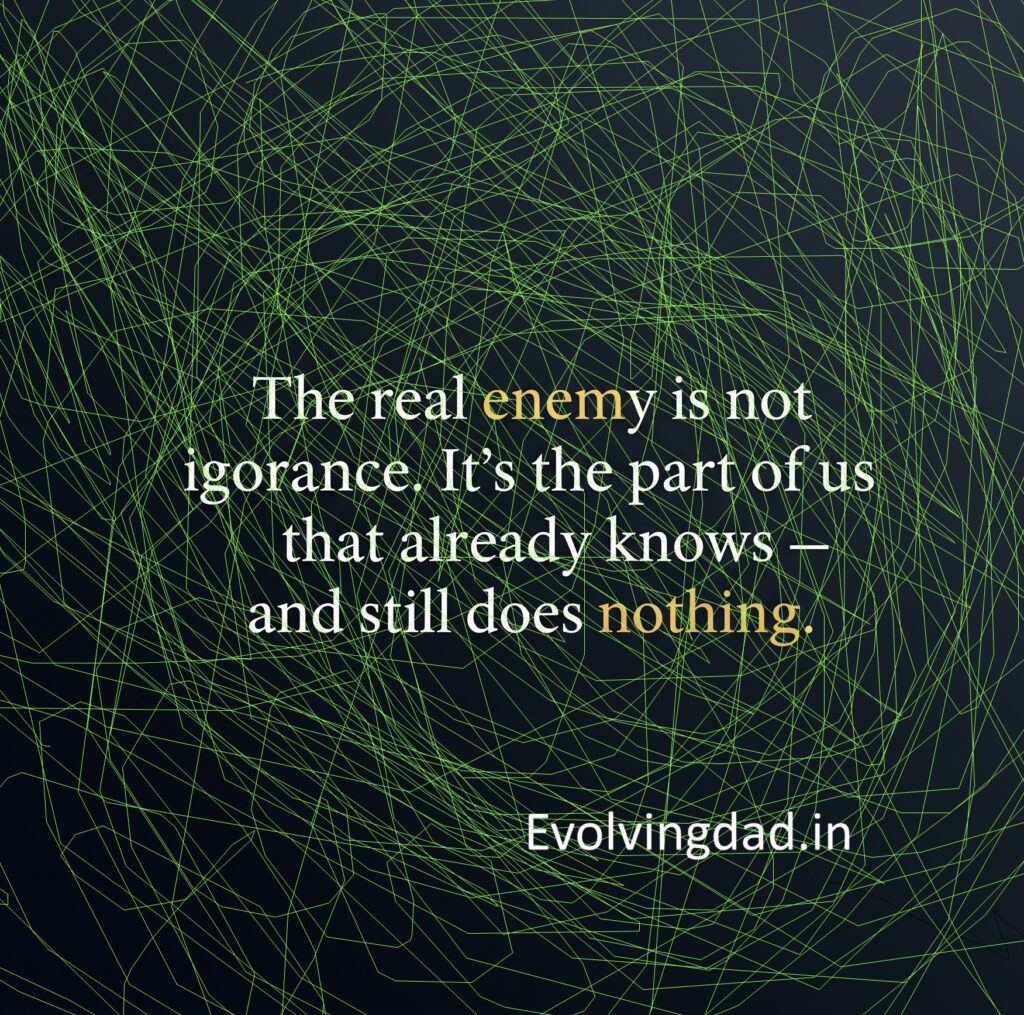
And so, the Gita begins not with a message of clarity, but with a mirror. A mirror showing us how dangerous it is to keep living in denial. Because the real enemy is rarely ignorance. It’s the part of us that already knows — and still does nothing.
3: “My Sons and the Pandavas” — Division Starts in the Mind
When Dhritarashtra asks Sanjaya about the battlefield, he doesn’t say, “What did both sides do?” or even “What did our children do?”
He says, “What did my sons and the Pandu’s sons do?” …By asking so he is drawing a subtle line between what is his and what is not.
It may look a small phrase, but it reveals something very massive and worth thinking.
Even at the doorstep of war, he clings to this division. He doesn’t see one family, one kingdom, one dharma. He sees mine versus theirs — and in doing so, he quietly exposes his bias, his attachment, and his inability to rise above ego.
And this isn’t just about Dhritarashtra.
We do this every day — drawing boundaries not just between people, but within ourselves.
We split our lives into sides:
“My comfort” vs. “my responsibility.”
“My desires” vs. “my discipline.”
“My truth” vs. “what’s actually right.”
Even when we’re torn inside, we pick a side which usually feels easier, safer, more familiar — and call it “mine.”
And when something feels like ours, we protect it, even if it’s wrong. We defend old habits. We cling to unhealthy identities. We nurture grudges, insecurities, and patterns — not because they serve us, but because they feel like us. Like home.
That’s exactly what Dhritarashtra is doing here.
He’s not confused about right and wrong.
He’s just not ready to let go of his “side,” even if that side leads to destruction.
In truth, the first battle of Kurukshetra was not fought with weapons.
It was fought in the language of division — in that one phrase: “my sons and the Pandavas.”
Because every war — whether outside or within — begins the moment we stop seeing clearly and start choosing sides that protect our ego instead of the truth.
4: symbolic reflections: When Truth Becomes Uncomfortable
The Gita doesn’t just say Kurukshetra. It calls it “Dharma-Kshetra, Kurukshetra” — the land of righteousness and the sacred field of dharma. That combination is not casual. The place where blood is about to spill, where families will collapse and fate will shift — is being called holy. Why? Because this is not just a physical battle. It’s actually an internal one. It’s a confrontation between truth and attachment, between comfort and conscience, between what we know is right and what we’ve chosen to protect instead.
And that’s exactly what makes Dhritarashtra’s question so telling. He knows what this land represents. He knows it stands for justice — something he failed to uphold. And that’s why this holy land has become a battleground. And now, his sons stand on this land, and he feels the weight of it. He feels exposed. Because when you’ve supported the wrong side for too long, even a holy place can feel like a threat. That’s what guilt does — it twists sacredness into discomfort, and clarity into confrontation. Not because the place has changed — but because we know we’ve been wrong.
This is something all of us face. We sit in silence, and the mind won’t stop reminding us of the things we’ve neglected. We open a scripture, and it feels like a mirror. We hear the truth, and it hurts — not because it’s harsh, but because it’s familiar. It’s exactly what we’ve been avoiding. We feel naked in front of our own conscience. And the more we’ve defended our attachments, the more threatened we feel by truth. But the wheels of time don’t stop for anyone. Slowly the Dharma-Kshetra of our mind becomes a battleground overtime
Dharma-Kshetra is not just a field in some distant epic. It’s that moment in our lives where the excuses no longer work. Where the air around us starts whispering, “You know what needs to be done. You just haven’t done it.” That’s what Dhritarashtra feared — not the war, but what it revealed about him.
And so, the Gita begins in this sacred land — not to glorify war, but to remind us: the real battlefield is within. And the moment you stand on the ground of truth, you can no longer lie to yourself.
“When you finally arrive at Dharma-Kshetra, don’t expect comfort.
Expect the truth to burn through every excuse you’ve ever made.”
5: Massage for all: The Art of Pretending Not to Know
Dhritarashtra ends his question with a quiet line: “kim akurvata Sanjaya?” — “What did they do, Sanjaya?”
At first glance, it seems harmless. But when you step into that moment deeply, when you feel the weight of the war building around him, this question feels far from innocent.
He already knew why the two armies were assembled. He knew who wronged whom. He knew that years of selective silence, passive support to grave injustice have brought this disaster to the edge. And yet, he asks, certainly not out of curiosity, but out of habitual denial. Because admitting the truth would mean accepting his role in it.
We’ve all been there.
We often act surprised at consequences that we ourselves invited. We pretend we didn’t see it coming — but deep inside, we did.
We delay change, not because we don’t know what needs to be done, but because doing it would hurt our ego
Because it would require courage. Ownership. Surrender. And that’s harder than pretending.
We say, “I don’t know what to do.”
But we do know.
We’ve always known.
We just don’t want to face it yet.
That’s what Dhritarashtra is doing here. He’s not confused — he’s avoiding.
Because once you accept that you know the truth, your excuses start to fall apart.
And when the excuses fall apart, action becomes your only option.
The Bhagavad Gita starts with that haunting kind of silence — the one that comes just before reality crashes in. The silence of a man who knows but refuses to say it out loud. Because once it’s spoken, everything must change.
And in that moment, we’re all Dhritarashtra —
Standing on the edge of our own Kurukshetra, asking questions we already know the answers to, hoping someone else will fight the battle for us.
“There’s nothing more exhausting than pretending you don’t know what your soul already whispers every day.”
Continue reading to the next blog about Geeta 1.2 and 1.3 https://evolvingdad.in/the-daily-battle-within-what-duryodhana-teaches-us-about-ego-growth/
Please read about my personal story and why i started this blog https://evolvingdad.in/from-lost-to-learning-why-i-started-evolving-dad/
You May Also Like
2 Comments
Pingback:
Pingback: