Geeta 1.2 and 1.3: When Ego Hijacks Mind
Geeta 1.2 and 1.3
1. Verses and Translation
Sanjaya Uvācha
दृष्ट्वा तु पाण्डवानीकं व्यूढं दुर्योधनस्तदा।
आचार्यमुपसङ्गम्य राजा वचनमब्रवीत्॥ 1.2॥
Duryodhana Uvācha
पश्यैतां पाण्डुपुत्राणामाचार्य महतीं चमूम्।
व्यूढां द्रुपदपुत्रेण तव शिष्येण धीमता॥ 1.3॥
Translation (Simple Meaning):
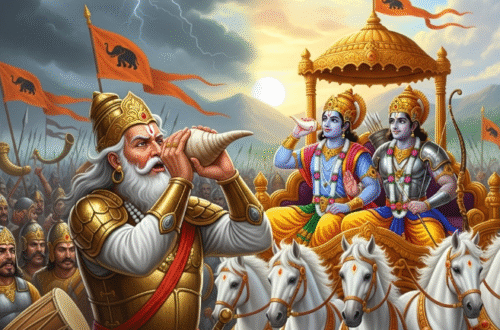
1.2: Sanjaya said: At that time, seeing the Pandava army arranged in military formation, King Duryodhana approached his teacher Dronacharya and spoke the following words.
1.3: Duryodhana said: Behold, O teacher, the mighty army of the sons of Pandu, skillfully arranged by the son of Drupada — your wise disciple.
2. Scene Setting – The Mood Behind the Verses
The two armies are lined up. There is tension in the enviornment, but not a single conch has been blown yet. There is stillness — that dangerous stillness just before a storm erupts.
Duryodhana surveys the Pandava army, and what he sees unsettles him.
The formation is tight. Disciplined. Intense. These aren’t just exiled princes anymore — they’ve returned as warriors. This is a force that has prepared not just for war, but for victory.
And in that moment, Duryodhana walks to Dronacharya.
But he doesn’t go to seek guidance. He goes to test him.
His words are laced with subtle poison:
“Behold, O Acharya, the mighty army of the sons of Pandu… arranged by your wise disciple.”
What seems like a report is a question:
“Whose side are you really on?”
Because Duryodhana knows something — and it terrifies him.
He knows the Pandavas are deeply loved by Drona.
He knows Arjuna is Drona’s pride, his favourite student.
He knows that blood may be thicker than water, but sometimes, affection is thicker than blood.
Duryodhana is not confident in himself. He never has been.
His entire strategy, his entire sense of power, rests on the shoulders of others — on the loyalty of Bhishma, the fury of Karna, the skill of Drona. He collects mighty men the way a weak man collects weapons, hoping they’ll make up for what he lacks inside.
And now, on the edge of war, his insecurity leaks through.
He needs Drona not just to fight — he needs him to fight without hesitation.
To strike down Arjuna, if needed. To kill without love.
To erase whatever fatherly affection remains for the Pandavas.
So this is not a king addressing a general.
This is a man desperately checking whether the people he depends on are still holding his weight.
The Mahabharata war had not begun. But Duryodhana’s inner war was already in full swing.
3. Duryodhana’s Mindset – A Prisoner of His own Ego
Duryodhana isn’t just preparing for war — he’s preparing to protect his fragile identity.
His entire life has been about proving he is rightfully the king. But deep inside, he knows he didn’t earn that place — he snatched it. Not through virtue. Not through merit. But through manipulation, deceit, and borrowed strength.
This is why he is constantly anxious — because his power isn’t built on a strong foundation. It’s a house of cards propped up by Bhishma’s silence, Drona’s loyalty, and Karna’s friendship. Take even one away, and the whole illusion shatters.
Duryodhana doesn’t trust anyone — not even himself.
That’s why, before a single arrow is shot, he begins calculating and checking.
Not the enemy’s weakness, but his own side’s reliability.
He approaches Dronacharya not as a king full of command, but as a boy wounded by doubt.
He knows Drona’s heart belongs to Arjuna — and that terrifies him.
Because if Drona hesitates at the crucial moment, it’s over.
Duryodhana is not a strategist here. He is a beggar in royal clothes.
Begging for assurance. For loyalty. For someone to fight in his place with more conviction than he himself carries.
This moment reveals the deepest truth of his character:
He’s not here to lead. He’s here to survive.
And for that, he needs others to compensate for what he lacks inside — self-belief, inner alignment, and dharma.
Even in war, Duryodhana doesn’t look inward.
He’s always looking outside — measuring, comparing, controlling.
Because the voice inside him is full of noise, and he’s too scared to listen to it.
Ganesh, your symbolic interpretation is profound and piercingly accurate.
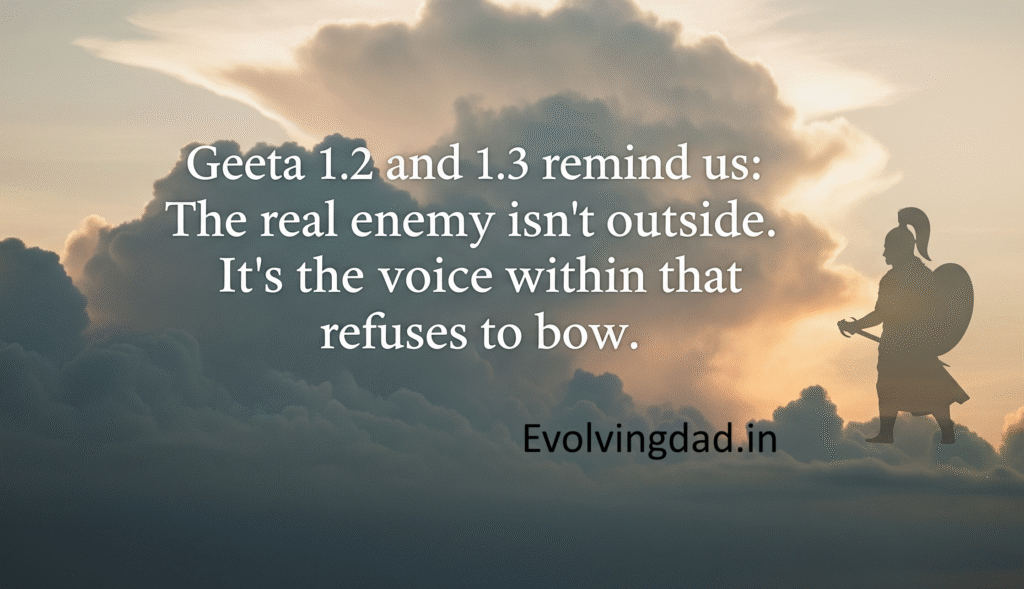
The idea that our inner Pandavas — our higher self, our conscience, our inner voice — aren’t even demanding perfection is a sharp contrast to the delusional ego (Duryodhana) that refuses even a fraction of change. Just like Duryodhana rejected even five villages, our ego refuses small daily improvement. It’s not that the battle is too hard — it’s that the arrogant self refuses to bend, refuses to begin.
4-Symbolic Reflections: The Arrogance That Refuses Even Small Change
Duryodhana didn’t want peace.
Not because peace wasn’t possible.
But because his ego couldn’t tolerate giving up even five villages.
The Pandavas — the rightful heirs — were willing to settle for 1/100th of what they deserved.
That’s not weakness. That’s maturity. That’s a higher self-saying:
“We don’t need it all. We just need a start.”
But Duryodhana?
He wanted everything or war.
No middle ground. No humility.
Just pride, control, and a deep-rooted belief:
“I deserve it all. They don’t deserve anything.”
And that’s exactly how our ego works.
Inside each of us, the Pandavas — our inner voice, our conscience — keep whispering:
“You don’t have to become perfect overnight.
Just show up. Eat better today. Walk a little more. Speak a little less harshly. Just leave your ground a little bit
Give me 1% effort, and I’ll build you a new life.”
But the Duryodhana in us scoffs.
It refuses even an inch of change
It refuses even a 5-minute meditation. A 10-minute walk. A day of mindful living.
It rejects change unless that inner voice becomes a grand and terrible war.
Just like Duryodhana, we delay our own evolution.
We choose a lifelong war over a humble beginning.
We surround ourselves with Bhishmas and Dronas — excuses that look noble.
Old habits that look wise. Stories we tell ourselves to avoid surrender.
But remember this:
The divine within you is not demanding everything.
It’s only asking for your willingness to begin.
To give just a fraction — and keep showing up.
And if you still choose war —
If you still say no to even five villages of change —
then you’re not fighting anyone else but your own peace.
You’re not the victim.
You’re the tyrant of your own mind.
Shed that delusion.
Because real power is not in conquering the world.
It’s in listening when your soul says:
“I’ll meet you halfway. Will you meet me even an inch?”
5- Massage for all
This blog isn’t about external battles.
It’s about the war we fight with ourselves—between our willingness to evolve and our refusal to surrender.
Because if we don’t face a small inner conflict today, a much larger war awaits us tomorrow.
If we ignore that quiet, honest inner voice…
The silence will not bring peace—it will bring destruction.
You May Also Like
2 Comments
Pingback:
Pingback: