Gita 2.10 to 12: Break Free From False Identity and Live as the eternal Self
Section 1: Gita 2.10 TO 2.12 verses with translation
In this blog we will discuss about Gita 2.10 TO 2.12
Bhagavad Gita 2.10
तमुवाच हृषीकेशः प्रहसन्निव भारत ।
सेनयोरुभयोर्मध्ये विषीदन्तमिदं वचः ॥
Translation:
“O Bharata, then Hrishikesha (Krishna), smiling as if in compassion, spoke these words to the grieving Arjuna, in the midst of both armies.”
Bhagavad Gita 2.11
अशोच्यानन्वशोचस्त्वं प्रज्ञावादांश्च भाषसे ।
गतासूनगतासूंश्च नानुशोचन्ति पण्डिताः ॥
Translation:
“You grieve for those who should not be grieved for, yet you speak words of wisdom. The truly wise do not mourn for the living or the dead.”
Bhagavad Gita 2.12
न त्वेवाहं जातु नासं न त्वं नेमे जनाधिपाः ।
न चैव न भविष्यामः सर्वे वयमतः परम् ॥
Translation:
“Never was there a time when I did not exist, nor you, nor these kings. Nor will there ever be a time when we shall cease to exist.”
Section 2: Teaching (Gita 2.10 TO 2.12)
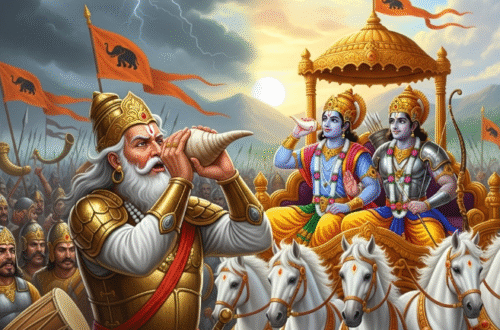
After Arjuna put down his bow, after he confessed his weakness and said, “I am your disciple, guide me,” the battlefield went silent. All eyes were on Krishna. What would He say?
And then came something no one expected.
Krishna smiled.
That smile is powerful. Why would He smile when his closest friend was breaking down, crying, trembling, refusing to fight? Because Krishna saw something Arjuna could not — the truth that his grief was built on illusion. Arjuna thought he was speaking great wisdom, saying, “How can I kill my teachers and family?” But Krishna knew this was not wisdom — this was emotional weakness, attachment which on surface looks like compassion.
So, Krishna began His teaching with a direct, piercing truth (Verse 2.11):
“You grieve for those who should not be grieved for. You speak words of wisdom, but the wise do not lament for the living or the dead.”
In one stroke, Krishna shattered the foundation of Arjuna’s sorrow. Death is not an end. Life is not something to cling to. The wise do not cry over what is temporary — whether life or death.
And then, in Verse 2.12, Krishna revealed the heart of the Gita:
“Never was there a time when I did not exist, nor you, nor these kings. Nor will there be a time when we shall cease to exist.”
This is not poetry. This is not a comforting line. It is a deepest truth: we are eternal. The body changes, generations rise and fall, kingdoms formed and destroyed, but the soul remains untouched.
With these words, Krishna shifted the conversation from Arjuna’s personal grief to the universal reality of existence. The Gita begins here.
Section 3: Symbolic reflection
When Krishna speaks in Gita 2.10 TO 2.12, He is not just telling Arjuna about life and death. He is pointing to something far more intimate — the death of our false identity and the discovery of our true Self.
Think about it: our bad habits, our addictions, our fears, our endless negative loops and talks — they don’t just live with us, they become part of us. Over time, they feel like family. They sit inside us like Bhishma, Drona — old, powerful, commanding respect, impossible to challenge. And like Arjuna, we collapse at the thought of fighting them. Because killing them feels like killing ourselves.
But here, Krishna draws a line of fire.
👉 “You grieve for what does not deserve grief.”
What He means is this: your problems, your false identity, your weaknesses — they are not worthy of your tears. They may feel real, but they are temporary. They are not the essence of who you are.
Then He strikes even deeper in Verse 12:
👉 “Never was there a time when you did not exist, nor will there be a time when you cease to exist.”
This is the truth: your false self will die — and it must die. The man trapped in addiction, guilt, and weakness must fall. But the true Self — the Atman — never dies. The death of the old you is not the end. It is the beginning. It is the rebirth into your higher nature.
Krishna is creating a separation in our minds — between the fragile identity we cling to, and the eternal soul that can never be destroyed. He is whispering:
👉 “You are not your mistakes. You are not your cravings. You are not the broken image you see in the mirror. Those are passing shadows. What is real in you — your eternal Self — has always been here and will always remain.”
When this realization lands, transformation becomes possible. You no longer fear the death of your old self. You no longer grieve over what is temporary. You welcome the death of your weaknesses because you know it is not your death — it is your liberation.
This is Krishna’s invitation in Gita 2.10 TO 2.12 to stop confusing yourself with your problems, and to finally live from the place of what cannot be destroyed.
Section 4: Closing Lines
The very first step in self-improvement, in healing, in transformation — or even in simply coming out of the darkest phases of life — is this: to separate yourself from your problems.
You are not your habits.
You are not your failures.
You are not your anxiety.
You are not your brokenness.
These are temporary layers. They rise and fall, they come and go, they are perishable.
But you are not.
You are indestructible. You are eternal. You are the Atman.
This is exactly what Krishna declares in Gita 2.10 TO 2.12. He is teaching us the first and most important truth:
👉 “Convince yourself that you are eternal, and that your problems are not. Only then will real growth begin.”
Because if you believe your problems, are you, you will never rise above them. But the moment you create that inner separation — “This weakness is not me, this addiction is not me, this fear is not me” — something shifts. The false self begins to die, and the true self begins to awaken.
This is the first step. The foundation. Without it, no practice, no meditation, no self-help technique will last. But with it, every step you take becomes powerful.
So do not grieve over the fall of your false self. Do not cling to the shadows that were never meant to last. Celebrate their death. Because what is temporary in you will pass, but what is eternal in you will remain — untouched, unbroken, indestructible.
This is Krishna’s smile in Gita 2.10 TO 2.12— a smile that tells you:
👉 “You are not your grief. You are not your darkness. You are the eternal soul, and nothing in this world can ever destroy you.”
Read my previous blog on Geeta Arjuna’s Surrender (Geeta 2.1–2.9): From Despair to Wisdom
Read my next blog on Geeta Geeta Verse 2.13: Your Simple Path to Fearless Change
You May Also Like
2 Comments
Pingback:
Pingback: