Geeta 1.12–1.18: Are You Making Noise or Anchoring in Truth?
Verses and translation
श्लोक 1.12
तस्य सञ्जनयन्हर्षं कुरुवृद्धः पितामहः।
सिंहनादं विनद्योच्चैः शङ्खं दध्मौ प्रतापवान्॥
Translation:
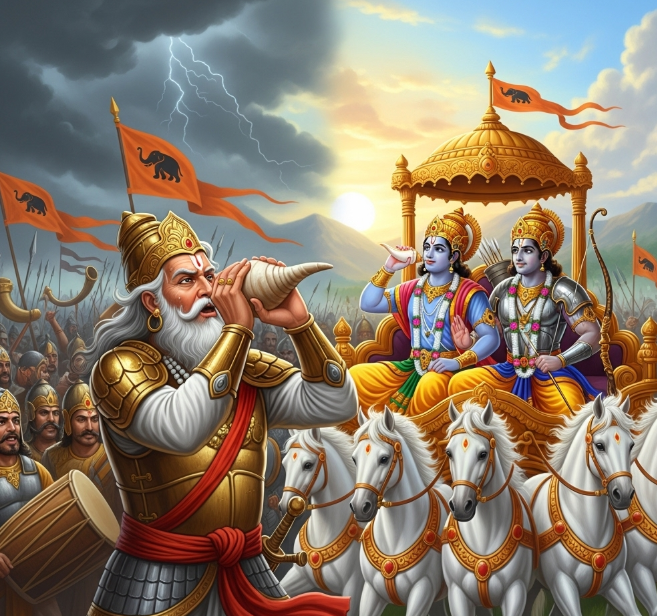
To cheer Duryodhana, the grand old Kuru, Bhishma, the powerful and glorious elder, blew his conch shell loudly, roaring like a lion.
श्लोक 1.13
ततः शङ्खाश्च भेर्यश्च पणवानकगोमुखाः।
सः सहसैवाभ्यहन्यन्त स शब्दस्तुमुलोऽभवत्॥
Translation:
Then suddenly, conches, drums, trumpets, tabors, and horns were sounded all at once, creating a tremendous noise.
श्लोक 1.14
ततः श्वेतैर्हयैर्युक्ते महति स्यन्दने स्थितौ।
माधवः पाण्डवश्चैव दिव्यौ शङ्खौ प्रदध्मतुः॥
Translation:
Then, seated in their magnificent chariot drawn by white horses, Madhava (Krishna) and the son of Pandu (Arjuna) blew their divine conches.
श्लोक 1.15
पाञ्चजन्यं हृषीकेशो देवदत्तं धनञ्जयः।
पौण्ड्रं दध्मौ महाशङ्खं भीमकर्मा वृकोदरः॥
Translation:
Hrishikesha (Krishna) blew his conch named Panchajanya; Dhananjaya (Arjuna) blew his conch named Devadatta; and Bhima, the doer of terrible deeds, blew the mighty conch Paundra.
श्लोक 1.16
अनन्तविजयं राजा कुन्तीपुत्रो युधिष्ठिरः।
नकुलः सहदेवश्च सुघोषमणिपुष्पकौ॥
Translation:
King Yudhishthira, the son of Kunti, blew the conch named Anantavijaya; Nakula and Sahadeva blew the conches named Sughosha and Manipushpaka.
श्लोक 1.17
काश्यश्च परमेष्वासः शिखण्डी च महारथः।
धृष्टद्युम्नो विराटश्च सात्यकिश्चापराजितः॥
Translation:
The King of Kashi, an excellent archer, the mighty car-warrior Shikhandi, Dhrishtadyumna, Virata, and the unconquerable Satyaki—all blew their conches.
श्लोक 1.18
द्रुपदो द्रौपदेयाश्च सर्वशः पृथिवीपते।
सौभद्रश्च महारथः शङ्खान् दध्मुः पृथक् पृथक्॥
Translation:
O King, Drupada, the sons of Draupadi, and the mighty-armed son of Subhadra (Abhimanyu), all blew their respective conches.
Scenic context: A Battlefield Divided by Sound and Intention
Before the war even begins, sound fills the air. But the sounds are different on both sides. On one side, Bhishma lifts his conch and blows it with all his strength. Not because he wants to.
But because he must. To uplift the spirit of Duryodhana.
He knows. Deep down, he knows. He’s fighting on the wrong side. His silence has already said more than his actions. But silence makes people uncomfortable—especially those looking for loyalty. So, he makes noise. Loud noise. A lion’s roar. To cover a divided heart with the sound of forced conviction.
That’s what starts the chain reaction—Drums, conches, horns, kettledrums. All blasting together, in a desperate attempt to sound strong. But the noise doesn’t always mean power.
Sometimes, it’s just panicky wearing Armor.
Across the field, there’s no such rush. No one’s trying to outdo anyone. Krishna and Arjuna sit still in their chariot And when they blow their conches, it’s not to intimidate someone. It’s not to impress. It’s to anchor. That sound isn’t loud. It’s solid.
One by one, the Pandavas and their allies raise their conches. They’re not performing. They’re not trying to fill any inner void. They are simply present—in body, mind, and purpose.
This section of the Gita doesn’t just describe the beginning of a war. It reveals something far more real: How two groups of people prepare— One fuelled by ego, noise, and pressure. The other, by alignment, steadiness, and clarity.
And that’s where the war begins—not with arrows, but with the energy behind a sound.
Symbolic Reflections: What Kind of Sound Lives Inside You?
This moment in the Gita is more than battlefield noise. It’s psychological warfare, and it holds a mirror to our daily lives. The Kaurava side is loud. Not because they’re powerful—but because they don’t know if they are.
When truth is missing, volume becomes the only saviour.
When you can’t stand on conviction, you lean on noise.
You shout, overstate, overperform—just to drown the silence that would otherwise reveal the insecurity you are standing on.
Bhishma’s roar wasn’t exactly only strength —it was more of a compensation.
A great man, fighting a war his heart never agreed with, doing what many of us do—making noise to silence guilt.
And that noise spreads. Others follow. Drums, horns, conches—everything blaring, not out of unity, but out of pressure. Because no one wants to be the quiet one in a room full of screaming. Even if that screaming is hollow.
Contrast that with Krishna and Arjuna. No panic. No rush. Just presence. Their sound isn’t about proving anything. It’s about anchoring themselves in dharma.
And it’s so calm, it cuts deeper than chaos ever could.
In our day-to-day life, this plays out constantly.
- The person who yells in arguments?
Usually the one feeling most out of control inside. - The louder someone gets when challenged?
The more fragile their confidence usually is.
Shouting is not strength. It’s the echo of inner weakness trying to look like power. Real strength doesn’t need to shout. It shows up, grounded and still. And in that stillness, it does more than a thousand words ever could.
So, the question is not how loud are you? It’s—how rooted are you?
Closing Insights: Listen Before You Shout
As we close this segment of the Gita, pause and ask yourself— What kind of sound is coming from your life right now? Are you trying to convince the world of your strength by raising your voice, appearing busier, showing off louder? Or are you quietly rooting yourself in truth, anchoring in your inner compass, knowing you don’t need to shout what’s already certain?
Bhishma’s conch was loud—but it came from inner conflict.
Krishna’s conch was calm—but it came from absolute clarity.
Both were sounds, but only one came from peace.
In today’s noisy world—filled with opinions, performances, and projections—the real revolution is inner stillness. Let others blow their conches to please their Duryodhanas. You, instead, sit beside your Krishna. And when you finally raise your voice, let it not be to prove yourself… But to align with something bigger than fear.

Please read here about Geeta 1.4 to 1.11Geeta1.4 to 1.11-Ego in the Battlefield
Please read next blog on Geeta 1.19 Geeta 1.19: The Shankh Naad That Shook the Heart
2 Comments
Pingback:
Pingback: