Geeta1.4 to 1.11-Ego in the Battlefield
In this blog we will cover Verse 1.4 to verse 1.11
1: Verses and Translation
Verse 1.4
अत्र शूरा महेष्वासा भीमार्जुनसमा युधि।
युयुधानो विराटश्च द्रुपदश्च महारथः॥
In this army, there are many heroic bowmen equal to Bhima and Arjuna — like Yuyudhana, Virata, and the mighty Drupada.
Verse 1.5
धृष्टकेतुश्चेकितानः काशिराजश्च वीर्यवान्।
पुरुजित्कुन्तिभोजश्च शैब्यश्च नरपुंगवः॥
Also Dhrishtaketu, Chekitana, the powerful King of Kashi, Purujit, Kuntibhoja, and the noble Shaibya are here.
Verse 1.6
युधामन्युश्च विक्रान्त उत्तमौजाश्च वीर्यवान्।
सौभद्रो द्रौपदेयाश्च सर्व एव महारथाः॥
Yudhamanyu, the valiant Uttamauja, the son of Subhadra (Abhimanyu), and the five sons of Draupadi—all are great chariot warriors.
Verse 1.7
अस्माकं तु विशिष्टा ये तान्निबोध द्विजोत्तम।
नायका मम सैन्यस्य संज्ञार्थं तान्ब्रवीमि ते॥
Now, O best of Brahmins, let me name the most distinguished of our side, for your understanding — the commanders of my army.
Verse 1.8
भवान्भीष्मश्च कर्णश्च कृपश्च समितिंजयः।
अश्वत्थामा विकर्णश्च सौमदत्तिस्तथैव च॥
Yourself (Drona), Bhishma, Karna, Kripa the conqueror of battles, Ashwatthama, Vikarna, and Bhurishrava—these are my top warriors.
Verse 1.9
अन्ये च बहवः शूरा मदर्थे त्यक्तजीविताः।
नानाशस्त्रप्रहरणाः सर्वे युद्धविशारदाः॥
Also many other heroes ready to lay down their lives for me, all skilled in the art of warfare and armed with various weapons.
Verse 1.10
अपर्याप्तं तदस्माकं बलं भीष्माभिरक्षितम्।
पर्याप्तं त्विदमेतेषां बलं भीमाभिरक्षितम्॥
Our strength, guarded by Bhishma, is unlimited. Theirs, protected by Bhima, is limited.
Verse 1.11
अयनेषु च सर्वेषु यथाभागमवस्थिता।
भीष्ममेवाभिरक्षन्तु भवन्तः सर्व एव हि॥
Therefore, all of you, stationed in your respective positions, give full support to Bhishma alone.
Section 2: Context in Mahabharata – A Speech Full of Ego and Insecurity
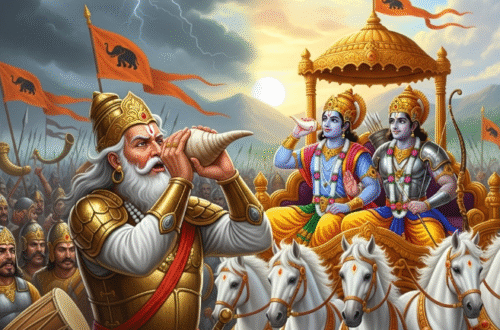
Duryodhana’s speech in verses 1.4 to 1.11 is addressed to Dronacharya, one of the commanders of the Kaurava army and guru to both the Pandavas and Kauravas.
But what strikes the listener is this —
Why is Duryodhana listing out warriors to Drona, who already knows each of them personally?
This is not a military strategy meeting. It’s a loose talk which is saturated with hidden insecurity and a performance of dominance.
He begins by naming the warriors on the Pandava side — not out of admiration, but with a layer of sarcasm, pretending they are great but subtly implying they are no match for his forces.
This isn’t strategy — it’s theatre. Duryodhana isn’t informing Drona; he’s convincing himself.
It’s a moment where his ego masks his inner fear — a delusional attempt to convince himself and others that his army, protected by Bhishma, is invincible. He ends his speech with a strong instruction — to protect Bhishma above all else — revealing the only place where he truly places his trust.
Section 3: The Shield Called Bhishma – Duryodhana’s Only Hope
Toward the end of his speech, Duryodhana declares: “All of you, stationed at your positions, protect Bhishma from all sides.” This command isn’t just about military protocol — it’s a clear signal of Duryodhana’s subconscious internal fear.
Among all the great warriors on his side — Drona, Karna, Ashwatthama — Duryodhana knows that only Bhishma truly commands the kind of power and presence that can hold the Pandavas back.
But even more than Bhishma’s skill, it is Bhishma’s vow that Duryodhana clings to:
Though the grandsire had pledged that he will not kill any Pandava, his presence to the Kaurava side also made Duryodhana’s protection evident. As long as Bhishma stood on the battlefield, Duryodhana knew no one could lay a finger on him. Duryodhana isn’t placing his trust in strategy. He is hiding behind Bhishma’s aura, using him as a human shield — both physically and emotionally.
This command — “Protect Bhishma!” — is a confession: Without Bhishma, Duryodhana is exposed. He knows that once Bhishma is gone, the war isn’t just difficult — it’s unwinnable.
Section 4: Symbolic Reflections – Echoes of Duryodhana Within Us
What Duryodhana says on the battlefield, we say every day — in relationships, arguments, and even in our self-talk.
🔸 Useless Information as a Distraction
We flood our minds with facts, judgments, and distractions — not to solve, but to avoid.
Like Duryodhana’s pointless list, we talk about everything but the only battlefield that matters: the one within.
🔸 Sarcasm Hiding Fear
It’s not confidence — it’s fear dressed as wit
Sarcasm doesn’t reveal strength. It hides weakness behind a smirk.
🔸 Bhishma as Our Last Pillar
Bhishma becomes a symbol of that one thing we cling to — a person, belief, or excuse we hope will save us. But deep down, we know: if that pillar falls, everything we’re hiding behind it collapses too.”
5: Closing Wisdom – When Confidence Rests on Illusion
“Duryodhana stood tall — confident, articulate, commanding.
His army was vast, his tone full of certainty.
But beneath that grandeur was a disconnection — not from the war, but from dharma.
His strength was loud, but hollow.
His speech was precise, but pointless.
His confidence was towering, but rooted in illusion.
This is what the Gita reveals —
Not all confidence is strength.
Sometimes, it’s ego in disguise, built on denial, supported by others, and destined to collapse when tested by truth.
In our lives too, we often carry ourselves like Duryodhana —
Armed with logic, lists, and loud declarations — but drifting far from our own inner compass.
So today, let us reflect:
- 🔸 What Bhishma am I hiding behind?
🔸 What truth am I trying to cover with noise and information?
🔸 Am I truly strong—or just trying to look strong?
Because when life brings its own battlefield, no name, no list, no Bhishma can shield us.
In that moment, only one thing matters —
whether the warrior within us is awake.”
Read about Geeta 1.2 and 1.3 Geeta 1.2 and 1.3: When Ego Hijacks Mind
Also read here about next Geeta verses Geeta 1.12–1.18: Are You Making Noise or Anchoring in Truth?

You May Also Like
One Comment
Pingback: