Geeta 1.19: The Shankh Naad That Shook the Heart
स घोषो धार्तराष्ट्राणां हृदयानि व्यदारयत् |
नभश्च पृथिवीं चैव तुमुलो व्यनुनादयन् ||
Translation:
That tumultuous sound pierced the hearts of the sons of Dhritarashtra,
resounding through the sky and the earth alike.
Introduction
In this Bhagavad Gita reflection, we dive into Chapter 1, Verse 19—a verse that holds deep symbolic meaning in the context of Dharma and the spiritual symbolism of the conch.
Scene Context: Why Only the Kauravas Felt That Fear
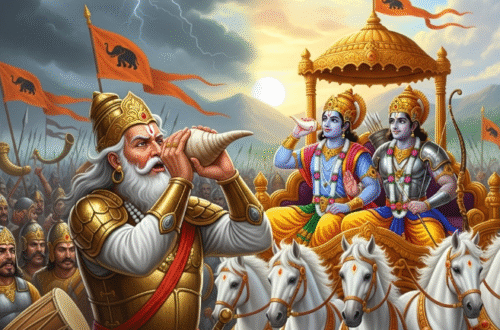
The conches blew across Kurukshetra.
First, Bhishma’s—loud, lion-like, meant to display dominance. Then Drona, Karna, Ashwatthama, Kripa, and the others. A chorus of pride and power. The Kauravas side was roaring.
But when the Pandavas lifted their conches… something changed.
Theirs wasn’t just sound—it was resolve.
It didn’t aim to intimidate. It declared inner readiness.
It wasn’t about showing off—it was their truth, spoken through the sound of a conch.
And in that moment, before the first arrow was fired, fear crept into the Kaurava camp.
Why? They had the larger army. Sharper weapons. Fierce warriors. The greatest commander in Bhishma. But they didn’t have Dharma. And no matter how loud the war cry, you cannot silence the inner voice that knows you’re standing on the wrong side.
The Pandavas were fewer. Surrounded. Outnumbered. But they stood on truth.
And truth doesn’t tremble—even in the face of death. That’s what gave their conch-blows weight. That’s what pierced the hearts of the Kauravas—not the sound, but the certainty behind it.
When you’re standing with Dharma, you don’t need to speak loudly. Even your silence carries weight. And when truth speaks, even in a whisper—it pierces louder than a thousand screams built on falsehood.
That is why the Kauravas were shaken.
And the Pandavas… stood unshaken.
Symbolic Reflections: The Whisper We Try to Silence
The conches of the Pandavas were not just instruments of war. They were instruments of truth.
Calm. Steady. Rooted in righteousness. They didn’t need to overpower anyone. They simply needed to declare: “We are aligned with Dharma.”
This is how our inner voice of truth speaks to us too.
“It doesn’t force its way in. It just waits—for the one moment you finally pause long enough to hear it.”
It waits for the day we are ready to listen.
But most of us aren’t. So, we drown it—every single day. We drown it in distractions: endless scrolling, shallow conversations, constant busyness. We drown it in ego—by convincing ourselves that we’re right, even when we know we’re wrong. We drown it in our narratives, our blame games, our justifications.
Because that voice…
That quiet voice inside… when you finally hear it, it shakes everything you’ve been pretending is okay.
And yet, no matter how loud we shout over it— it remains. Quietly persistent. Like the Pandava conches, it doesn’t seek to frighten or overpower. It seeks to awaken.
And the moment we finally hear it—when it breaks through the noise and touches our heart—
everything starts to tremble. Not because it’s terrifying, but because it reveals everything, we’ve worked so hard to hide.
It brings us face-to-face with our past— the people we’ve hurt, the chances we’ve wasted, the values we’ve compromised.
It shows us how far we’ve drifted from our real self.
In that moment, the heart doesn’t just tremble. It cracks open.
Sometimes the truth doesn’t argue or explain—it just breaks you open, exactly where you need healing That’s what happened when the Pandavas blew their conches. Their sound didn’t shake the sky.
It shook the souls of those who had abandoned Dharma. That’s why the Kauravas felt fear. When you know deep down you’re not on the right side, even a quiet voice of truth can shake you to your core.
And when truth speaks, even in a whisper—
it pierces louder than a thousand screams built on falsehood.
Closing Insights: Listen Before It’s Too Late
The battlefield of Kurukshetra is not just an ancient story. It is the battlefield of our everyday life.
Every single day, we are standing between two armies— one side is our ego, pride, fear, and false justifications. The other side is our dharma, truth, and inner voice.
We may have built massive armies around us— money, status, logic, defenses, excuses. But when that one quiet whisper of truth finally emerges— just like the conches of the Pandavas—
everything else starts to feel hollow.
Because truth needs no army. It needs no volume.
It simply needs a space in your heart.
And if you’re standing on the wrong side, you will feel that tremble. You will feel that unease. You might call it stress or say you’re just tired—but deep down, it’s often the pain of drifting away from what you know is right The Kauravas had everything—power, people, numbers. But they lacked one thing: Dharma.
And that’s why the same sound that gave the Pandavas strength…pierced their hearts with fear.
Ask yourself—what side are you standing on today?
Because the voice of your truth is still blowing the conch. Still calling you to rise.
Are you ready to stop shouting over it… and finally, just listen?
These Bhagavad Gita reflections are not just for spiritual seekers—they are for anyone navigating the battlefields of daily life
Read here about Geeta verses 1.12- to 1.18 Geeta 1.12–1.18: Are You Making Noise or Anchoring in Truth?
Also read our next blog on Geeta 1.20- 1.24 Geeta Verses 1.20–1.24: A Chariot Stopped Between Right and Wrong


You May Also Like
2 Comments
Pingback:
Pingback: