From Geeta Verse 2.14: Endurance as first quality to embibe
Geeta verse 2.14 with translation
Sanskrit Verse (2.14):
मात्रास्पर्शास्तु कौन्तेय शीतोष्णसुखदुःखदाः।
आगमापायिनोऽनित्यास्तांस्तितिक्षस्व भारत।।
Translation:
O son of Kunti, the contact of the senses with their objects brings cold and heat, pleasure and pain. They are temporary, coming and going. Endure them with patience, O descendant of Bharata.
Geeta Teaching – Geeta verse 2.14
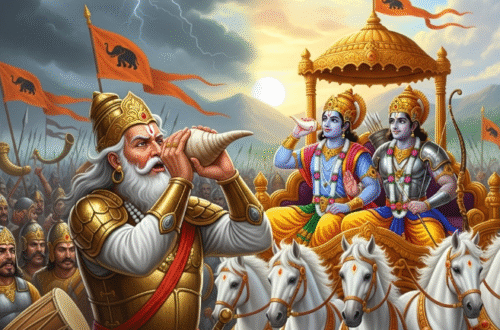
In Geeta verse 2.14, Lord Krishna addresses Arjuna, who is paralyzed on the battlefield by sorrow and moral confusion. Arjuna cannot bear the thought of fighting against his own loved ones. Krishna, having just explained in verse 2.13 that the soul is eternal and unaffected by the death of the body, now shifts Arjuna’s attention to another key truth: how to deal with the inevitable ups and downs of life.
The verse says: “O son of Kunti, the contact of the senses with their objects brings cold and heat, pleasure and pain. These experiences are temporary; they come and go. Therefore, endure them with patience, O descendant of Bharata.”
Krishna is pointing to two profound inevitabilities here. First, the contact of the senses with external objects cannot be avoided. As long as we live in this body, our senses will meet with situations, people, and environments. This contact will produce pleasant and unpleasant sensations, joy and sorrow, comfort and discomfort. No human being can escape this.
Second, Krishna reminds Arjuna that the temporary nature of these experiences is also inevitable. Just as day follows night, and summer is replaced by winter, all experiences—whether painful or pleasurable—come and go. Nothing remains fixed. This is the very nature of worldly life.
This understanding forms the basis of Krishna’s instruction of Titiksha, or endurance. Endurance does not mean becoming insensitive or pretending emotions don’t exist. Rather, it means facing life’s sensations with calm awareness, knowing that both pain and pleasure are fleeting. Summer heat may feel unbearable, but it passes. The joy of spring feels delightful, but it fades too. If one clings to joy or runs away from pain, one is bound to suffer. But when one understands their impermanence, balance and clarity naturally arise.
For Arjuna, this lesson was crucial—only by recognizing the inevitability of both joy and sorrow could he rise above his paralyzing emotions and fulfil his dharma. For us too, this teaching is a timeless guide: accept that life’s dualities cannot be escaped but also know that they cannot hold you forever.
Symbolic Reflection
Geeta verse 2.14 reveals not just a teaching for Arjuna, but a mirror for each of us. It highlights a fundamental truth: the very fact of living means we will encounter both pleasant and unpleasant experiences. Life’s nature is such that joy and sorrow, comfort and discomfort, praise and criticism are inescapable. To live is to feel, and to feel is to face both sides of this duality.
Yet, our instinct is to avoid pain and cling to pleasure. We resist discomfort as if it should not exist, and we hold on to happiness as if it should last forever. But Krishna reminds us: even happiness, even comfort, is a trap if we become attached to it. Because the moment comfort goes away—and it will—the resulting pain feels sharper. This clinging and resisting keeps us trapped in a cycle where every experience generates more emotions, and every emotion creates new reactions. We end up spinning endlessly in this loop of joy and sorrow, never breaking free.
This is where Krishna introduces Titiksha—endurance. Titiksha is not about suppressing emotions or becoming indifferent. It is the capacity to face life’s waves without losing balance. Just as a calm lake reflects both storm clouds and sunlight without distortion, Titiksha allows us to stay centred amidst changing life circumstances.
To understand this balance, imagine life as a bicycle. The two wheels are pleasure and pain, happiness and sorrow. Both are necessary; without either wheel, the bicycle cannot move forward. But if we cling to one wheel or try to ride sitting on a wheel itself, the cycle will topple. The right way is to sit in the middle seat, higher than both wheels. From there, we can use both wheels to move forward steadily. Similarly, in life, if we rise above the pull of pleasure and pain, we can move toward our higher goal. If we cling to either side, we get stuck and fall.
This is why Krishna stresses Titiksha as the very first quality to cultivate. Without endurance, we remain slaves to every emotional rise and fall. With endurance, we gain the strength to keep moving towards our purpose, unmoved by the constant turning of life’s dualities. Titiksha is not weakness—it is the very power that keeps us free, steady, and progressing on the path of self-mastery despite the life situations
Closing Insights
Geeta verse 2.14 offers us a profound key to living wisely. Krishna does not deny the reality of life’s experiences. He does not say that pain will disappear or that joy will last forever. Instead, he points us to the very nature of existence: sensations, emotions, and experiences are inevitable, and their temporary nature is equally inevitable. Recognizing both truths frees us from unnecessary struggle.
Most of our suffering comes not from the experiences themselves, but from our reactions to them. We resist what feels unpleasant, which only deepens the pain. We cling to what feels pleasant, which creates anxiety and fear of loss. Back and forth, like a pendulum, we swing between craving and aversion. In this endless loop, our energy is consumed, and we lose sight of the real purpose of life—not chasing comfort but becoming the best version of ourselves.
Krishna introduces Titiksha—endurance—as the first quality necessary to change. With Titiksha, we do not suppress our emotions, nor do we indulge them blindly. We simply endure, holding steady, allowing experiences to come and go without letting them dictate our actions. Endurance is what gives us the ability to keep moving forward despite challenges, setbacks, or even successes.
Endurance is the invisible thread behind every meaningful achievement. Without it, life remains a chain of emotional reactions. With it, life becomes a purposeful journey.
The message of Geeta verse 2.14 is simple yet transformative: do not get trapped in the seesaw of pleasure and pain. Instead, rise above both, endure them with patience, and stay focused on your higher goal. This is the way to inner freedom, and this is the starting point of true spiritual strength.
As you reflect on this teaching, ask yourself: What emotions am I clinging to today? What discomfort am I resisting? And how can I practice Titiksha—endurance—so that I remain steady, and true to my real purpose?
Read my previous blog on Geeta 2.13 Geeta Verse 2.13: Your Simple Path to Fearless Change
You May Also Like
One Comment
Pingback: