Spiritual insights
“Learnings from the Geeta and spiritual reflections through my journey.”
-
From Geeta Verse 2.14: Endurance as first quality to embibe
Geeta verse 2.14 with translation Sanskrit Verse (2.14):मात्रास्पर्शास्तु कौन्तेय शीतोष्णसुखदुःखदाः।आगमापायिनोऽनित्यास्तांस्तितिक्षस्व भारत।। Translation:O son of Kunti, the contact of the senses with their objects brings cold and heat, pleasure and pain. They are temporary, coming and going. Endure them with patience, O descendant of Bharata. Geeta Teaching – Geeta verse 2.14 In Geeta verse 2.14, Lord Krishna addresses Arjuna, who is paralyzed on the battlefield by sorrow and moral confusion. Arjuna cannot bear the thought of fighting against his own loved ones. Krishna, having just explained in verse 2.13 that the soul is eternal and unaffected by the death of the body, now shifts Arjuna’s attention to another key truth: how…
You May Also Like
Geeta 1.12–1.18: Are You Making Noise or Anchoring in Truth?
-
Geeta Verse 2.13: Your Simple Path to Fearless Change
1. Verse with Translation (Geeta verse 2.13) Sanskrit Verseदेहिनोऽस्मिन्यथा देहे कौमारं यौवनं जरा ।तथा देहान्तरप्राप्तिर्धीरस्तत्र न मुह्यति ॥ २.१३ ॥ Translation“Just as the soul passes in this body from childhood to youth to old age, so also at death the soul passes into another body. The wise are not bewildered by such a change.” 2- Geeta teaching Geeta 2.13 verse marks the beginning of Krishna’s spiritual teaching to Arjuna. Up to this point, Arjuna has been overwhelmed with grief and confusion at the thought of fighting his loved ones. His heart is heavy with the fear of death and destruction. Krishna now gently shifts the focus by introducing the most…
You May Also Like
Geeta 1.12–1.18: Are You Making Noise or Anchoring in Truth?
-
Gita 2.10 to 12: Break Free From False Identity and Live as the eternal Self
Section 1: Gita 2.10 TO 2.12 verses with translation In this blog we will discuss about Gita 2.10 TO 2.12 Bhagavad Gita 2.10 तमुवाच हृषीकेशः प्रहसन्निव भारत ।सेनयोरुभयोर्मध्ये विषीदन्तमिदं वचः ॥ Translation:“O Bharata, then Hrishikesha (Krishna), smiling as if in compassion, spoke these words to the grieving Arjuna, in the midst of both armies.” Bhagavad Gita 2.11 अशोच्यानन्वशोचस्त्वं प्रज्ञावादांश्च भाषसे ।गतासूनगतासूंश्च नानुशोचन्ति पण्डिताः ॥ Translation:“You grieve for those who should not be grieved for, yet you speak words of wisdom. The truly wise do not mourn for the living or the dead.” Bhagavad Gita 2.12 न त्वेवाहं जातु नासं न त्वं नेमे जनाधिपाः ।न चैव न भविष्यामः सर्वे वयमतः परम्…
You May Also Like
Geeta 1.12–1.18: Are You Making Noise or Anchoring in Truth?
-
Bhagavad Geeta 1.31–1.47: Defense Mechanisms of the Mind in Arjuna’s Struggle
Section 1: Geeta 1.31-1.47 Verse 1.31 न च श्रेयोऽनुपश्यामि हत्वा स्वजनमाहवे ।न काङ्क्षे विजयं कृष्ण न च राज्यं सुखानि च ॥ 31 ॥ Translation:I do not see any good in killing my own people in this battle. O Krishna, I do not desire victory, nor kingdom, nor pleasures. Verse 1.32 किं नो राज्येन गोविन्द किं भोगैर्जीवितेन वा ।येषामर्थे काङ्क्षितं नो राज्यं भोगाः सुखानि च ॥ 32 ॥ Translation:Of what use will kingdom, happiness, or even life itself be to us, O Govinda, when all those for whom we desire them stand here for battle? Verse 1.33 त इमेऽवस्थिता युद्धे प्राणांस्त्यक्त्वा धनानि च ।आचार्याः पितरः पुत्रास्तथैव च पितामहाः ॥ 33 ॥…
You May Also Like
Geeta 1.12–1.18: Are You Making Noise or Anchoring in Truth?
-
When Battlegrounds Turn Within: Arjuna’s Inner Breakthrough (Gita 1.25–1.30)
Section 1 – Verses with Translation Verse 1.25भीष्मद्रोणप्रमुखतः सर्वेषां च महीक्षिताम्।उवाच पार्थ पश्यैतान् समवेतान् कुरूनिति॥ २५॥ Translation:Placing the chariot before Bhishma, Drona, and all the rulers of the earth, Krishna said:“O Partha, behold these Kurus gathered here.” Verse 1.26तत्रापश्यत्स्थितान् पार्थः पितॄन् अथ पितामहान्।आचार्यान् मातुलान् भ्रातॄन् पुत्रान् पौत्रान् सखींस्तथा॥श्वशुरान् सुहृदश्चैव सेनायोरुभयोरपि॥ २६॥ Translation:There, Arjuna saw standing in both armies: fathers, grandfathers, teachers, maternal uncles, brothers, sons, grandsons, friends, fathers-in-law, and well-wishers. Verse 1.27तान्समीक्ष्य स कौन्तेयः सर्वान्बन्धूनवस्थितान्।कृपया परयाविष्टो विषीदन्निदमब्रवीत्॥ २७॥ Translation:Seeing all his relatives assembled there, the son of Kunti was filled with deep compassion and spoke these words in sorrow. Verse 1.28अर्जुन उवाच —दृष्ट्वेमं स्वजनं कृष्ण युयुत्सुं समुपस्थितम्।सीदन्ति मम गात्राणि मुखं…
You May Also Like
Geeta 1.12–1.18: Are You Making Noise or Anchoring in Truth?
-
Geeta Verses 1.20–1.24: A Chariot Stopped Between Right and Wrong
Verses and Translation Sanskrit:अथ व्यवस्थितान् दृष्ट्वा धार्तराष्ट्रान् कपिध्वजः।प्रवृत्ते शस्त्रसम्पाते धनुरुद्यम्य पाण्डवः॥ Translation:Then, seeing the sons of Dhritarashtra (Kauravas) positioned in battle, Arjuna, whose chariot bore the emblem of Hanuman, raised his bow in preparation to fight. Verses 1.21–1.22 Sanskrit:हृषीकेशं तदा वाक्यमिदमाह महीपते।सेनयोरुभयोर्मध्ये रथं स्थापय मेऽच्युत॥यावदेतान्निरीक्षेऽहं योद्धुकामानवस्थितान्।कैर्मया सह योद्धव्यमस्मिन् रणसमुद्यमे॥ Translation:At that time, Arjuna said to Krishna (Hrishikesha):“O Achyuta, place my chariot between the two armies so I may observe those assembled here who are eager for battle, and see with whom I must fight.” Verse 1.23 Sanskrit:योत्स्यमानानवेक्षेऽहं य एतेऽत्र समागताः।धार्तराष्ट्रस्य दुर्बुद्धेर्युद्धे प्रियचिकीर्षवः॥ Translation:Let me see those who have gathered here to fight, eager to please the evil-minded son of Dhritarashtra…
You May Also Like
Geeta 1.12–1.18: Are You Making Noise or Anchoring in Truth?
-
Geeta 1.19: The Shankh Naad That Shook the Heart
स घोषो धार्तराष्ट्राणां हृदयानि व्यदारयत् |नभश्च पृथिवीं चैव तुमुलो व्यनुनादयन् || Translation:That tumultuous sound pierced the hearts of the sons of Dhritarashtra,resounding through the sky and the earth alike. Introduction In this Bhagavad Gita reflection, we dive into Chapter 1, Verse 19—a verse that holds deep symbolic meaning in the context of Dharma and the spiritual symbolism of the conch. Scene Context: Why Only the Kauravas Felt That Fear The conches blew across Kurukshetra. First, Bhishma’s—loud, lion-like, meant to display dominance. Then Drona, Karna, Ashwatthama, Kripa, and the others. A chorus of pride and power. The Kauravas side was roaring. But when the Pandavas lifted their conches… something changed. Theirs…
You May Also Like
Geeta 1.12–1.18: Are You Making Noise or Anchoring in Truth?
-
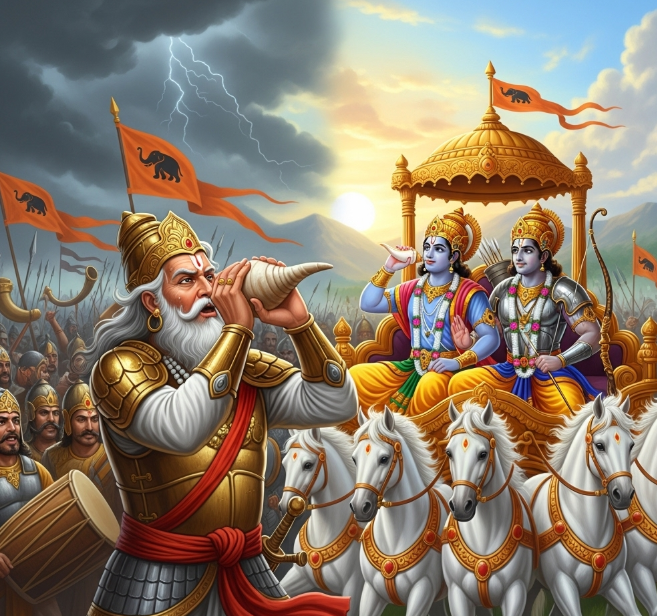
Geeta 1.12–1.18: Are You Making Noise or Anchoring in Truth?
Verses and translation श्लोक 1.12 तस्य सञ्जनयन्हर्षं कुरुवृद्धः पितामहः।सिंहनादं विनद्योच्चैः शङ्खं दध्मौ प्रतापवान्॥ Translation:To cheer Duryodhana, the grand old Kuru, Bhishma, the powerful and glorious elder, blew his conch shell loudly, roaring like a lion. श्लोक 1.13 ततः शङ्खाश्च भेर्यश्च पणवानकगोमुखाः।सः सहसैवाभ्यहन्यन्त स शब्दस्तुमुलोऽभवत्॥ Translation:Then suddenly, conches, drums, trumpets, tabors, and horns were sounded all at once, creating a tremendous noise. श्लोक 1.14 ततः श्वेतैर्हयैर्युक्ते महति स्यन्दने स्थितौ।माधवः पाण्डवश्चैव दिव्यौ शङ्खौ प्रदध्मतुः॥ Translation:Then, seated in their magnificent chariot drawn by white horses, Madhava (Krishna) and the son of Pandu (Arjuna) blew their divine conches. श्लोक 1.15 पाञ्चजन्यं हृषीकेशो देवदत्तं धनञ्जयः।पौण्ड्रं दध्मौ महाशङ्खं भीमकर्मा वृकोदरः॥ Translation:Hrishikesha (Krishna) blew his conch named…
-
Geeta1.4 to 1.11-Ego in the Battlefield
In this blog we will cover Verse 1.4 to verse 1.11 1: Verses and Translation Verse 1.4अत्र शूरा महेष्वासा भीमार्जुनसमा युधि।युयुधानो विराटश्च द्रुपदश्च महारथः॥In this army, there are many heroic bowmen equal to Bhima and Arjuna — like Yuyudhana, Virata, and the mighty Drupada. Verse 1.5धृष्टकेतुश्चेकितानः काशिराजश्च वीर्यवान्।पुरुजित्कुन्तिभोजश्च शैब्यश्च नरपुंगवः॥Also Dhrishtaketu, Chekitana, the powerful King of Kashi, Purujit, Kuntibhoja, and the noble Shaibya are here. Verse 1.6युधामन्युश्च विक्रान्त उत्तमौजाश्च वीर्यवान्।सौभद्रो द्रौपदेयाश्च सर्व एव महारथाः॥Yudhamanyu, the valiant Uttamauja, the son of Subhadra (Abhimanyu), and the five sons of Draupadi—all are great chariot warriors. Verse 1.7अस्माकं तु विशिष्टा ये तान्निबोध द्विजोत्तम।नायका मम सैन्यस्य संज्ञार्थं तान्ब्रवीमि ते॥Now, O best of Brahmins, let me…
You May Also Like
Geeta 1.12–1.18: Are You Making Noise or Anchoring in Truth?
-
Geeta 1.2 and 1.3: When Ego Hijacks Mind
Geeta 1.2 and 1.3 1. Verses and Translation Sanjaya Uvāchaदृष्ट्वा तु पाण्डवानीकं व्यूढं दुर्योधनस्तदा।आचार्यमुपसङ्गम्य राजा वचनमब्रवीत्॥ 1.2॥ Duryodhana Uvāchaपश्यैतां पाण्डुपुत्राणामाचार्य महतीं चमूम्।व्यूढां द्रुपदपुत्रेण तव शिष्येण धीमता॥ 1.3॥ Translation (Simple Meaning):1.2: Sanjaya said: At that time, seeing the Pandava army arranged in military formation, King Duryodhana approached his teacher Dronacharya and spoke the following words.1.3: Duryodhana said: Behold, O teacher, the mighty army of the sons of Pandu, skillfully arranged by the son of Drupada — your wise disciple. 2. Scene Setting – The Mood Behind the Verses The two armies are lined up. There is tension in the enviornment, but not a single conch has been blown yet. There is…
You May Also Like
Geeta 1.12–1.18: Are You Making Noise or Anchoring in Truth?