Bhagavad Geeta 1.31–1.47: Defense Mechanisms of the Mind in Arjuna’s Struggle
Section 1: Geeta 1.31-1.47
Verse 1.31
न च श्रेयोऽनुपश्यामि हत्वा स्वजनमाहवे ।
न काङ्क्षे विजयं कृष्ण न च राज्यं सुखानि च ॥ 31 ॥
Translation:
I do not see any good in killing my own people in this battle. O Krishna, I do not desire victory, nor kingdom, nor pleasures.
Verse 1.32
किं नो राज्येन गोविन्द किं भोगैर्जीवितेन वा ।
येषामर्थे काङ्क्षितं नो राज्यं भोगाः सुखानि च ॥ 32 ॥
Translation:
Of what use will kingdom, happiness, or even life itself be to us, O Govinda, when all those for whom we desire them stand here for battle?
Verse 1.33
त इमेऽवस्थिता युद्धे प्राणांस्त्यक्त्वा धनानि च ।
आचार्याः पितरः पुत्रास्तथैव च पितामहाः ॥ 33 ॥
Translation:
Here stand our teachers, fathers, sons, grandfathers, uncles, in-laws, grandsons, and friends, all ready to give up their lives and wealth in battle.
Verse 1.34
मातुलाः श्वशुराः पौत्राः श्यालाः सम्बन्धिनस्तथा ।
एतान्न हन्तुमिच्छामि घ्नतोऽपि मधुसूदन ॥ 34 ॥
Translation:
Uncles, fathers-in-law, grandsons, brothers-in-law, and other kinsmen too—O Madhusudana, I do not wish to kill them, even if they attack me.
Verse 1.35–36
अपि त्रैलोक्यराज्यस्य हेतोः किं नु महीकृते ।
न हि प्रीत्याऽस्मि हन्तुं गुरूनहत्वा हि महानुभावान् ॥ 35 ॥
लोकसंघारकृन्तान्नः प्रीतिः स्याज्जनार्दन ।
पापमेवाश्रयेदस्मान्हत्वैतानाततायिनः ॥ 36 ॥
Translation:
Even if I were to gain sovereignty over the three worlds, I would not wish to kill them, let alone for the earth. O Janardana, what joy would we get by slaying our teachers? Killing these high-souled men would only bring sin upon us.
Verse 1.37–38
तस्मान्नार्हा वयं हन्तुं धार्तराष्ट्रान्स्वबान्धवान् ।
स्वजनं हि कथं हत्वा सुखिनः स्याम माधव ॥ 37 ॥
यद्यप्येते न पश्यन्ति लोभोपहतचेतसः ।
कुलक्षयकृतं दोषं मित्रद्रोहे च पातकम् ॥ 38 ॥
Translation:
Therefore, it is not proper for us to kill the sons of Dhritarashtra, our kinsmen. How can we be happy by slaying our own relatives, O Madhava? Even if they, blinded by greed, do not see the wrong in destroying the family and betraying friends…
Verse 1.39
कथं न ज्ञेयमस्माभिः पापादस्मान्निवर्तितुम् ।
कुलक्षयकृतं दोषं प्रपश्यद्भिर्जनार्दन ॥ 39 ॥
Translation:
Why should we, who can clearly see the evil in destroying a family, not turn away from this sin, O Janardana?
Verse 1.40
कुलक्षये प्रणश्यन्ति कुलधर्माः सनातनाः ।
धर्मे नष्टे कुलं कृत्स्नमधर्मोऽभिभवत्युत ॥ 40 ॥
Translation:
When the family is destroyed, the ancient traditions of the family perish. With the loss of dharma, lawlessness overwhelms the entire family.
Verse 1.41
अधर्माभिभवात्कृष्ण प्रदुष्यन्ति कुलस्त्रियः ।
स्त्रीषु दुष्टासु वार्ष्णेय जायते वर्णसङ्करः ॥ 41 ॥
Translation:
When adharma prevails, O Krishna, the women of the family become corrupt. When women are corrupted, O descendant of Vrishni, a mixture of varnas (social chaos) arises.
Verse 1.42
सङ्करो नरकायैव कुलघ्नानां कुलस्य च ।
पतन्ति पितरो ह्येषां लुप्तपिण्डोदकक्रियाः ॥ 42 ॥
Translation:
Such intermingling leads the family and its destroyers to hell. The ancestors fall, deprived of ritual offerings of food and water.
Verse 1.43
दोषैरेतैः कुलघ्नानां वर्णसङ्करकारकैः ।
उत्साद्यन्ते जातिधर्माः कुलधर्माश्च शाश्वताः ॥ 43 ॥
Translation:
The sins of those who destroy the family and cause varna mixing lead to the ruin of eternal family and social duties.
Verse 1.44
उत्सन्नकुलधर्माणां मनुष्याणां जनार्दन ।
नरकेऽनियतं वासो भवतीत्यनुशुश्रुम ॥ 44 ॥
Translation:
We have heard, O Janardana, that those who destroy family traditions dwell in hell indefinitely.
Verse 1.45
अहो बत महत्पापं कर्तुं व्यवसिता वयम् ।
यद्राज्यसुखलोभेन हन्तुं स्वजनमुद्यताः ॥ 45 ॥
Translation:
Alas! How strange that we are bent on committing this great sin—driven by the desire for kingdom and pleasures, we are ready to kill our own kinsmen.
Verse 1.46
यदि मामप्रतीकारमशस्त्रं शस्त्रपाणयः ।
धार्तराष्ट्रा रणे हन्युस्तन्मे क्षेमतरं भवेत् ॥ 46 ॥
Translation:
If the sons of Dhritarashtra, weapons in hand, were to kill me in battle while I am unarmed and unresisting, that would be better for me.
Verse 1.47
सञ्जय उवाच ।
एवमुक्त्वाऽर्जुनः सङ्ख्ये रथोपस्थ उपाविशत् ।
विसृज्य सशरं चापं शोकसंविग्नमानसः ॥ 47 ॥
Translation:
Sanjaya said: Having spoken thus on the battlefield, Arjuna cast aside his bow and arrows and sat down on the chariot, his mind overwhelmed with sorrow.
Section 2 – Scenic Context: Arjuna’s Despair
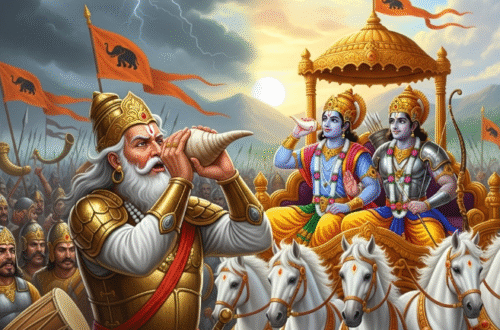
As we saw in the previous verses, Arjuna’s eyes had fallen upon Bhishma, Drona, and all his dear ones standing in the enemy camp. The weight of that sight crushed his warrior spirit. His hands began to tremble, his legs felt weak, and his once-mighty Gandiva bow slipped from his grasp. His throat went dry, his chest heavy with a knot of grief, as he turned to Krishna and told him that he could not fight them.
Now, in verses 1.31 to 1.47, we will see Arjuna’s despair by a psychological lens. Arjuna begins explaining why he cannot fight. One reason follows another, each layered with emotion, morality, and fear. He speaks of omens, of the sin of killing family, of the destruction of dharma, of the downfall of society, of the eternal suffering that follows. To the casual listener, it sounds like he is making a noble, selfless decision.
But think about it, does Krishna, the God Himself, the knower of past, present, and future, really need an explanation of what is right or wrong? No. These justifications are not for Krishna’s benefit. Arjuna is not convincing Krishna; he is convincing himself. These words are not commands of his heart but the excuses of his mind, scrambling to avoid the pain and burden of action.
Deep inside, Arjuna knows his duty. But the mind resists the hard path. It seeks comfort in a thousand logical arguments for inaction. Arjuna, the greatest archer of his time, is now wrestling not with the Kaurava army, but with his own mind. In this inner battle, every excuse feels like relief, and he is desperately trying to side with the easier choice: to not fight, to let the Kauravas rule, and to walk away from the war altogether.
Section 3: Symbolic Reflection – The Excuses We Sell to Ourselves
When Arjuna sees Bhishma, Drona, and his loved ones in the enemy ranks, he starts listing the reasons for avoiding the fight. On the surface, he’s speaking to Krishna. In reality, he’s speaking to himself, building a wall of excuses so high that even truth can’t climb over it.
We do the same.
When life presents us with a battle — breaking a bad habit, confronting our own mediocrity, repairing a relationship, or taking the leap toward our goals — we pull out our personal list of “why nots.”
- “It’s not the right time.”
- “It will hurt too many people.”
- “I don’t want to lose what little I already have.”
- “It’s too risky.”
- “I’ve already been through enough.”
We tell the world these reasons to sound rational. But the truth? We’re telling them to ourselves to avoid the discomfort of change. Psychologists have a name for this: defence mechanisms. Sometimes it’s rationalization—fear dressed up as logic. Sometimes it’s projection—blaming circumstances or people around us for what is actually our own hesitation. Sometimes it’s simple avoidance—slipping away quietly so we never have to face the heat.
Over time, these excuses harden into identity. “I’m just not that kind of person.” “I can’t handle confrontation.” “I work better under pressure, so I’ll start later.” This is no longer about the battle outside; it’s about the war we refuse to fight inside.
Arjuna’s trembling bow is our trembling willpower. His refusal is our endless delay. And just like him, we often mistake our self-preserving stories for truth, until we’ve convinced even ourselves that surrender is wisdom.
Closing Insights – The Battle We Don’t Admit We’re Avoiding
If you strip away all the justifications, the grand philosophies, and the “practical” reasons we tell ourselves… most excuses are simply shields. Shields we’ve been carrying for years, maybe decades, convincing ourselves they’re Armor when in reality they’re just cages.
Arjuna’s battlefield hesitation isn’t some ancient warrior problem—it’s the human condition. We all have our Kurukshetra. And when the fight gets too close to the heart, our mind becomes a genius at spinning stories: “This isn’t the right time,” “I don’t want to hurt anyone,” “I’m just being realistic,” “It’s not worth the trouble.”
The truth? These are not reasons—they’re defence mechanisms. They protect us from the discomfort of growth.
Psychologists call them rationalization, avoidance, denial. Spiritually, they’re the whispers of the ego that’s terrified of being dismantled. And the more we repeat them, the more they become part of our identity. We stop just making excuses—we become the excuse.
So, here’s the raw reality: No one else is holding us back. Not our family, not society, not circumstance. Only us. Until we face our own inner Bhishmas and Dronas—the old loyalties, the false securities—we’ll keep standing in the chariot, bow lowered, spinning stories about why this battle is not worth it.
But deep down, we know the truth. This isn’t just a battle—it’s the only one that truly matters.
Read The previous blog on Geeta When Battlegrounds Turn Within: Arjuna’s Inner Breakthrough (Gita 1.25–1.30)
Read my next blog From initial verses from Adhyay 2 Arjuna’s Surrender (Geeta 2.1–2.9): From Despair to Wisdom
You May Also Like
One Comment
Pingback: